Capturing Your Family’s Story Jul 27, 2021
I wasn’t someone who asked many questions about my parents’ lives — or those of my grandparents. I lived with bits and fragments, and for a long time, that felt enough.
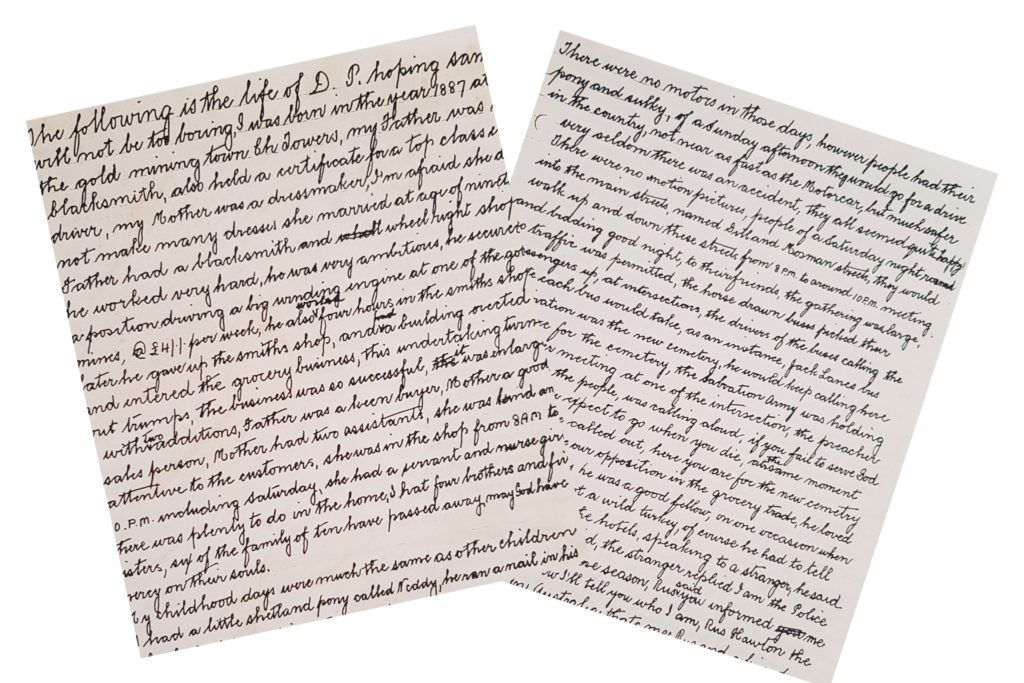
But everything changed when I came across a copy of my paternal grandfather’s life story — written in his own handwriting. What I found stunned me. Here, in his own words, was a history of risk and resilience, of striving and survival. And as I read, I recognised something of myself: the same entrepreneurial spirit, the same values.
I chose some of his phrases and wove them into our family album — not as an act of nostalgia, but an act of belonging. One line read, “I was keen to get out of poverty lane” — and that was only the beginning of a remarkable journey: youth, gold‑rush shares, miners’ work, sugar cane fields, cattle properties, picture‑theatres, a bookmaker’s ventures. Through each phase, two constants stood out: honesty and hard work.
Stories Are More Than Just Happy Snapshots
Our family stories don’t have to be perfect or polished to be meaningful. They don’t need only the cheerful moments — they can, and perhaps should, include the hardship, the struggles, the comebacks.
My grandfather recounted times on the land that were unforgiving: illness, floods, crop failures, cyclones. Farms destroyed. Crops lost. Years of hardship. But in spite of it all — or perhaps because of it — he pushed on. He rebuilt, reinvented, tried again.
These stories aren’t just memories. They are testimonies of resilience. They remind us where we came from — and help show us where we might go.
Conversations That Matter
I once read a piece by a writer reflecting on his mother’s childhood under dramatically different circumstances than our modern life. She grew up without electricity, yet lived to see smartphones and social media. That gap between her world and ours struck me — but more powerful was the story he told: a simple question and an honest answer revealed a lifetime of change, values, hopes, and hard-earned wisdom.
When he gently asked her, “What made the biggest difference in your life?” — he opened a door to history, to memory, to meaning. We don’t need to overthink these conversations. We just need to ask — with curiosity, respect, and heart.
Why It Matters to Capture It — Now
- Your family story gives identity a foundation. When children see their history — the wins, the struggles, the values — they understand that they didn’t come from nowhere. They belong to something bigger.
- It helps them appreciate resilience and authenticity. Life is rarely tidy. By acknowledging imperfections alongside triumphs, you show children that strength and integrity are built — not given.
- It gives them a sense of heritage and pride. Family albums — whether filled with photos, stories, keepsakes — become treasure chests of identity. When children and grandchildren look through them, they see not just ancestors, but possibilities.
- It teaches gratitude, perspective, and humility. Seeing where you came from — the challenges, sacrifices, and growth — helps form a grounded, empathetic mindset.
A Call to Begin — Questions to Spark Your Family’s Story
I believe everyone has a story worth telling. Simple, honest, human. If you’re ready to start capturing yours, here are some gentle prompts to get you going:
- What are the earliest memories you have of home when you were a child?
- What are the hardest challenges your parents or grandparents faced, and how did they respond?
- What values did they cherish — and how have those shaped you?
- What are the small, everyday moments that bring a smile — a tradition, a childhood game, a family recipe, a holiday memory?
- If you had to pick three life lessons from your ancestors, what would they be?
- How do you hope your children or grandchildren will remember you?
(And if you like — I’m preparing a full list of 50+ prompts to help families reflect, remember, and record. Happy to share when you’re ready.)
Something for Them to Own
What we do when we capture our story isn’t just for us — it’s for our children, their children, and maybe even further down the line.
With every handwritten note, printed photo, or carefully chosen moment, we build a legacy. One of truth, memory, belonging — and hope. When you pass on a family album to the next generation, you give them more than pictures. You give them identity. You give them roots. And in doing so — perhaps most importantly — you give them something to own.